skip to main |
skip to sidebar
.jpg) Click here to read an article I came across a while back.
Click here to read an article I came across a while back.
It raises the possibility that there are one or more abandoned cemeteries on the hill above Havre de Grace. It seems hard to believe considering the saturation of residential development in the area. A friend who grew up in town convinced me that there could be any number of lost burial grounds from the Civil War era located between Havre de Grace and Darlington.
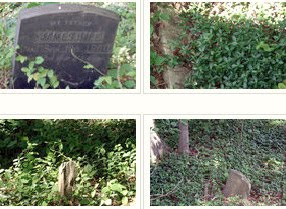
In a little patch of brush on the side of Chapel Road, in the comfort provided by some old trees, sits the place I believe to be Johnson-Hill Cemetery. Some of you are familiar with it, possibly from your youths. Others would be as surprised as I was to learn that abandoned burial sites lie, hidden from view, in the shadows cast by one of the county's most prized communities.
The burial ground is marred by the eerie depressions formed when wooden caskets decay. Some of the grave sites are marked by etched tombstones, some are proudly distinguished by natural stones of varying sizes, most are recognizable only by sunken earth. A fair number of people are buried there.
A tall tree, possibly a source of shade and peacefulness in the past, now encroaches upon the grave of Civil War soldier Luis Hill. Luis rests next to his father James. Josephine, the young bride of Freeborn Curtis, was barely 21 years old when laid to rest in the little cemetery on Chapel Hill. She died in the year after the Civil War ended. We can only imagine the dignity felt by a black man named Freeborn during that ugly time. It says much about the people who lived here then.
The Ghosts of Havre de Grace began as a project to collect haunted stories about the area. It still is with one important distinction: I've leaned that the real ghosts of Havre de Grace are the remarkable people and places whose memories have regrettably faded in time, but are not entirely forgotten.
Gravediggers working with shovels in darkness to unearth caskets, disrupting the sleep of the dead: Could it be the faint memory of a distant childhood nightmare? Could it be the faded recollection of a horrific tale heard long ago?
It happened during the early morning hours of June 25, 1929 at Angel Hill Cemetery in the quiet town of Havre de Grace.
In the dim light cast by a full moon behind low clouds, M. H. Andrews, superintendent of Angel Hill Cemetery, his son, Clifford and two laborers carried out the grisly task at hand. To avoid frenzied crowds of townsfolk, 3 AM was the designated hour to exhume the bodies of Edward Stone and Edgar Stone, the deceased husband and son of Hattie Stone.
Hattie, in the custody of authorities at the time, was the target of a murder investigation that pointed to the intentional poisoning of her 15 year old son, George, who had died a couple of weeks earlier. Edgar had passed away two years before his brother; Edward had been dead just a year and a half. All three, at the time of their deaths, presented symptoms suggesting they had been poisoned with strychnine. The authorities wanted to know if the rumors circulating around town were true: Did Hattie Stone murder her family?
As might be expected, the bizarre case drew the intense focus of media attention.
The caskets were taken by undertakers George and Robert Pennington, father and son, to their funeral parlor in town. George Pennington was then the mayor of Havre de Grace. The viscera (internal organs) were removed from the corpses to be delivered to Baltimore for chemical analysis.
The caskets were swiftly returned to Angel Hill where they were placed back in the earth, next to George's grave, while the town still slept.
The old house sits on Market Street, its view of the river stolen by development. Bonnie, not her real name , used to live there with her husband and children. Odd things happened. Household items would move while no one was around. Laundry left in a pile would be found neatly folded. Sounds were heard in the attic, like the sounds made by wood being moved around.
At first, the couple assumed that their young sons were to blame for the strange occurrences.
In time, Bonnie came to sense the presence of a woman in the house. Her encounters with the paranormal heightened. While going down the stairs, she would catch fleeting glimpses of the backs of someone's feet descending the stairs in front of her. Her husband remained skeptical even though Bonnie once saw the full bodied apparition of a woman wearing a blue dress. Bonnie used the word "blue" repeatedly and definitively to describe not only the ghostly dress, but the entire room where she encountered the spirit.
While sitting on the first floor with her husband and 3 dogs, something happened to convert her husband into a believer. The dogs suddenly cowered together for no apparent reason. The couple smelled a musty odor, like seaweed. Then a coldness descend upon them only to disappear suddenly along with the inexplicable smell. The dogs' demeanor then returned to normal.
Bonnie and her family eventually moved from the house on Market Street, but not because of the paranormal activity. After coming to terms with the nature of the encounters, Bonnie wasn't threatened by the ghost.
It should be noted: the family came to completely avoid the attic.
Bonnie believes that the spirit belonged to a woman who reportedly hung herself in the house.
The events shared here took place roughly 50 years ago.
Young, popular, and beautiful, Annie McMaster's future was full of promise. She was, after all, engaged to marry Daniel Kenley, 14 years older than her and well respected in the town of Havre de Grace. Daniel once worked as a bridge builder, but had landed an enviable position with the federal fish commission.
Annie's family rented a comfortable frame cottage on Stokes Street near the center of town. She lived with her mother Susanna, her brother William, and her sister Alice. Her father had passed away after moving the family to town from Cecil County somewhere near Elkton.
Annie McMaster, described as cheerful and bright, did the unthinkable during the early morning hours of June 4, 1889.
Holding her brother's revolver so near her chest that her clothing was burned, Annie ended the promise of her very bright future. The report of the revolver echoed through the quiet streets of Havre de Grace alerting the town that something fatal had happened. A neighbor, Mrs. James Hand, rushed into the house to find Annie's mother, Susanna, leaning over her dying daughter. The sight had to be gruesome. Annie lied on her family's sofa for an hour, blood flowing freely, before she passed away.
The suicide of a young lady, known to be likable and pleasant, shocked the town of Havre de Grace. Hundreds came to the family's house on Stoke's Street to pay their respect and view Annie's body lying in a casket. Remember, Annie lived during a time when corpses were laid out and viewed in the homes of the deceased.
Annie McMaster's body was buried in a family plot at Angel Hill Cemetery in a peaceful setting near the hill's crest. She was just 21 years old.
The source of Annie's desperation followed her to the grave. One account tells of a disagreement between Annie and Daniel the night before Annie committed suicide. The couple had paid a social visit to the house of one of Annie's sisters who lived nearby.
What was said between the Annie and Daniel? Did Daniel break the engagement? We will never know.
The story of Annie McMaster, like the story of Hattie Stone, has long faded from the memory of townsfolk. Then again, there are always those distant memories of the tales told to us during our childhoods. The fear evoked by those stories seems to stay with us always though the details somehow became vague.
While growing up in Havre de Grace, is it possible the someone told you a ghostly story about a young lady, possibly nameless, that haunts a house on Stokes Street?
In 1929, Havre de Grace took the national spotlight as the gruesome details of a series of murders were revealed. A town resident, Hattie Stone, was convicted for the death of her 15 year old son George - Strychnine poisoning was thought to be the cause - who died in the midst of convulsions following a "hearty meal prepared by his mother." ( Miami News - June 20, 1929 ) .
At the time, Hattie's highly publicized prosecution was referred to as the "Poison Trial."
Authorities suspected that Hattie was also responsible for the deaths of other family members including her husband George Stone, her father-in-law John Stone, her mother-in-law Emma Stone, and another son Edgar. Upon examination, the exhumed corpses of Hattie Stone's family indicated deaths due to unnatural causes.
Her family members lie now, as they did then, in Angel Hill Cemetery in the town of Havre de Grace. All reportedly died under similar circumstances, namely stomach trouble..
Insurance proceeds were allegedly the motive for Hattie's brutal acts. Newspaper articles from the time indicate that insurance policies named Hattie as beneficiary.
Prosecutors painted the picture of a woman with a scandalous lifestyle who may have considered her sole surviving son George as a hindrance. In the words of State's Attorney, W. Worthington Hopkins: "She was the kind of a woman who wanted to be running around all the time with the men."
Keep in mind, the Havre de Grace that Hattie Stone might have enjoyed during the 1920's was a much different place than the quiet tourist town it is today. Home to "The Graw," a prominent thorough-bred racetrack, the town embraced illegal drinking, prostitution and, of course, gambling as part of it's notorious sub-culture. If Hattie was looking for a good time, assuming she had the cash to fund her antics, Havre de Grace was the place to be.
What happened to Hattie Stone? One elderly town resident recalls that Hattie worked as a waitress in Baltimore after serving her prison sentence. Has anyone heard a different ending to Hattie's story?
What about the tortured souls of Hattie's murder victims?
Are they at rest or do they linger in Havre de Grace as a paranormal reminder of a horrible, yet forgotten, secret from the town's past?
Let's start with a promise: this site isn't about ghost hunting techniques or the high tech equipment used by popular paranormal investigators. I'm just hoping to spark a little discussion about the folklore and legends of the unusual and historic town known as Havre de Grace, Maryland and other interesting places in Harford County and nearby Cecil County.
As a relative newcomer to town, I'm surprised at the absence of rumor and small talk concerning haunted sites or just tales about local ghosts. It seems strange that the long, sometimes traumatic, history of Havre de Grace isn't interwoven with the whispers of paranormal activity that distinguish other towns with similar pasts.
I suspect that others have searched for the ghosts of Havre de Grace and came back nearly empty handed as well.
Or maybe not.
Please leave a comment, or send an email to hdg.ghosthunter@ gmail.com, if you've heard tales of a Havre de Grace haunting or if you've had a personal experience with the ghosts that surely reside here.
.jpg)

